
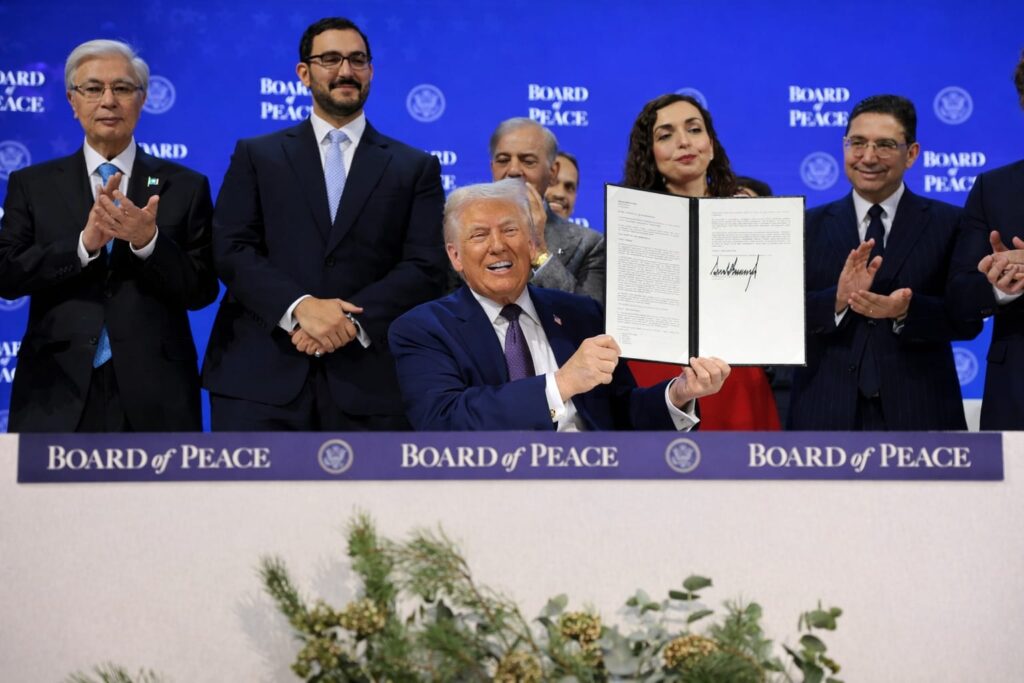
At the World Economic Forum (WEF) in Davos, US President Donald Trump formally unveiled a new international initiative called the “Peace Board”, pitching it as a platform aimed at shaping post-conflict pathways in areas long affected by violence. While representatives from 19 countries were present during the announcement, India was notably absent, a detail that has drawn the attention of diplomatic observers and global policy analysts.
The launch comes against a backdrop of increased geopolitical uncertainty, with the Gaza conflict, renewed global power rivalry and shifting alliances dominating the international discussion. According to US officials, the peace board is intended to serve as an advisory framework to explore reconstruction, governance models and economic stabilization in war-affected areas, with Gaza emerging as one of the primary focus areas.
A Carefully Curated Global Gathering
The event was attended by leaders and senior representatives from Europe, the Middle East, Central Asia and parts of Africa. Attendees included heads of state, foreign ministers and senior diplomats, signaling Washington’s intention to present the board as a broad-based international effort rather than a one-off project.
Officials accompanying the announcement emphasized that the Board is not designed as a formal treaty body, but rather as a strategic forum where participating countries can exchange ideas, assess humanitarian needs and outline long-term recovery scenarios. This initiative is expected to be held periodically, with policy recommendations rather than binding decisions.
However, the absence of several influential global players – most prominently India – has raised questions about the reach and credibility of the initiative.
India’s Absence and Strategic Significance
India’s decision not to participate has been interpreted by analysts as a reflection of its cautious approach towards externally driven conflict-resolution frameworks. New Delhi has traditionally supported multilateral institutions such as the United Nations while maintaining strategic autonomy in foreign policy decisions.
India’s growing global influence, particularly in the Global South, means that its absence from such initiatives does not go unnoticed. Diplomatic experts suggest New Delhi may seek greater clarity on the board’s mandate, leadership structure and long-term objectives before engaging.
Others say India has consistently advocated inclusive dialogue and region-specific solutions, particularly with regard to the Middle East, and may prefer established international mechanisms over newly announced platforms led by a major power.
Overshadowed by Controversy
While the Board of Peace was positioned as a forward-looking initiative, its rollout was partially overshadowed by unrelated remarks made earlier in the week by President Trump regarding Greenland. Those comments, followed by a rapid clarification and retreat, shifted media attention and sparked debate about Washington’s broader foreign policy priorities.
As a result, the peace initiative received a mixed reception, with some observers questioning whether the announcement achieved the diplomatic momentum originally intended. Despite this, U.S. officials insisted that discussions around the Board would continue beyond Davos, with further consultations planned in the coming months.
Focus on Gaza’s Future
At the center of the board’s proposed agenda is the future of the Gaza Strip. Officials described the initiative as an effort to address governance, reconstruction funding and security arrangements after active hostilities subside. However, the approach stops short of outlining specific political solutions, instead emphasizing “economic stabilization” and “institutional reconstruction.”
This framing has drawn cautious reactions from humanitarian experts, who insist that local representation, international law, and humanitarian accountability must be prioritized in any long-term plan for Gaza. Analysts warn that without these elements, external initiatives will be seen as disconnected from realities on the ground.
Mixed International Reactions
Reactions from participating nations have been measured. Some welcomed the creation of an additional platform for dialogue, arguing that complex conflicts require multiple channels of engagement. Others maintained that success would depend on how inclusive and transparent the Board ultimately proves to be.
Diplomats also highlighted the importance of coordination with existing international bodies to avoid duplication or conflicting policy signals. In this context, the absence of countries like India may limit the initiative’s ability to claim broad global consensus.
What Lies Ahead
The Board of Peace remains in its early stages, and its actual impact will depend on whether it evolves beyond symbolic diplomacy. Key questions remain unanswered: Will it engage with regional stakeholders directly? How will it align with international humanitarian frameworks? And can it gain the trust of countries that have chosen to stay outside the initiative for now?
For India, continued engagement through other diplomatic channels suggests that absence from this specific forum does not indicate disengagement from global peace efforts. Instead, it underscores New Delhi’s preference for cautious, principle-based participation in international initiatives.
As global conflicts continue to test diplomatic innovation, the Board of Peace represents one of several emerging efforts to redefine post-conflict engagement. Whether it becomes a meaningful contributor to global stability or remains a high-profile but limited forum will become clearer in the months ahead.
India was absent as U.S. President Donald Trump launched the “Board of Peace” at the World Economic Forum, raising questions about the initiative’s global reach and diplomatic impact.