
Introduction
The international system in 2026 is undergoing subtle but significant changes. Unlike dramatic wars or headline-grabbing summits, today’s global changes are happening through diplomacy, trade restructuring, energy transitions and strategic partnerships. For countries like India, these changes matter a lot, as they affect foreign policy decisions, economic growth and national security. Understanding these trends is essential for both competitive exam aspirants and conscious citizens.
Changing Balance of Power
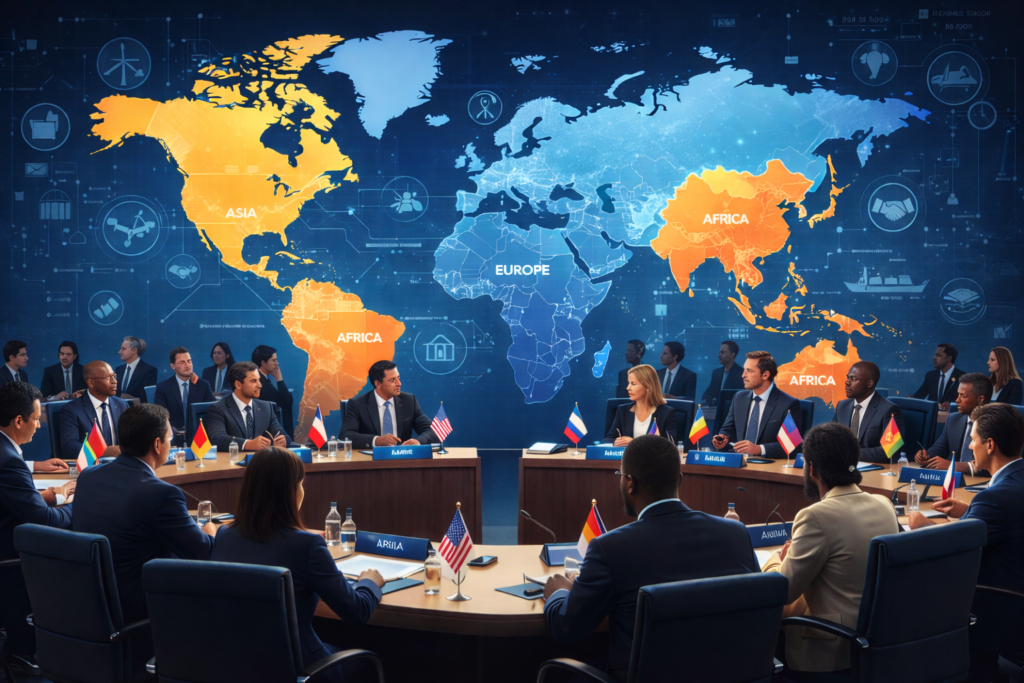
For decades, global politics revolved primarily around Western powers. However, recent years have seen a gradual shift towards a multipolar world order, where influence is shared among many countries rather than dominated by a single bloc.
Countries in Asia, Africa and Latin America are increasingly emphasizing their interests. Regional powers are strengthening their voices in international institutions, while traditional powers are reevaluating their global roles. This redistribution of influence is reshaping diplomacy, trade agreements and global governance.
This tendency is important when studying topics such as world order, global governance, and international relations, for exam preparation.
Role of Emerging Economies
Emerging economies are playing a bigger role in global decision making. Their growing population, expanding markets and strategic location make them important partners in international cooperation.
Economic blocs and regional alliances are gaining importance as countries seek alternatives to traditional power centres. This has encouraged greater South-South cooperation focusing on shared development goals, infrastructure development and technology exchanges.
From the Indian perspective, this supports India’s long-term goal of becoming a leading voice among developing countries while maintaining strategic autonomy.
Energy Security and Climate Diplomacy
Energy has become one of the most important issues in global politics. Countries are balancing the need for economic growth with climate commitments. Renewable energy investment is increasing, while nations remain cautious about sudden changes that could affect energy security.
Climate diplomacy is no longer limited to environmental discussions – it now influences trade policies, foreign aid and global negotiations. Developing countries are demanding fair climate financing and technology transfer, making climate justice a central international issue.
This topic is especially relevant for GS Paper II and III in UPSC, which includes Environment, Economy and International Agreements.
Strategic Competition Without Direct Conflict
A notable trend in 2026 is competition without direct confrontation. Instead of large-scale conflicts, countries are using diplomacy, economic policies, technology development, and regional influence to advance their interests.
Trade regulations, supply chain diversification and digital infrastructure have become strategic tools. Nations are also investing heavily in innovation, cybersecurity, and space technologies, recognizing that future power will depend more on knowledge and resilience than military strength alone.
This reflects a shift from conventional war to strategic competition, a key concept for the study of international relations.
India’s Position in the Global Landscape
India continues to strengthen its diplomatic engagement with many regions while avoiding rigid alliances. Its focus on dialogue, development cooperation and multilateralism enhances its credibility on the global stage.
By connecting with both developed and developing countries, India positions itself as a bridge between different world regions. This approach is in line with India’s long-standing foreign policy principles of strategic autonomy and peaceful coexistence.
For the exam aspirants, India’s emerging global role is an essential topic in the preliminary and main examination.
Why This Matters for Competitive Exams
Questions in competitive exams focus more on conceptual clarity rather than memorizing. Understanding global trends helps candidates analyze current affairs, write balanced answers and link international developments with India’s national interests.
Topics like multipolarity, energy security, climate diplomacy and emerging economy are frequently asked in UPSC, SSC and state level examinations.
Conclusion
The global order in 2026 is not changing overnight, but its direction is clear. Power is becoming more distributed, diplomacy is becoming more complex, and cooperation is becoming more essential. For India, these changes present both opportunities and responsibilities.
For students and readers, staying informed about such international developments builds a strong foundation for examinations and encourages a deeper understanding of how the world works today.
This article is for informational and educational purposes only and does not represent official policy or opinions.