
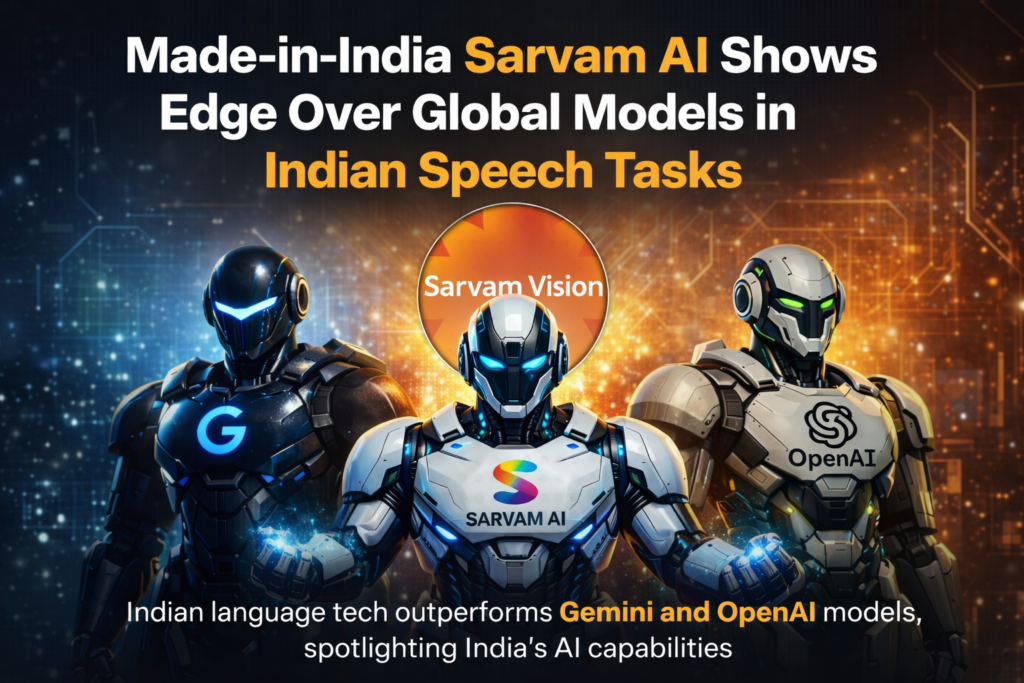
India’s artificial intelligence ecosystem has received renewed attention after Sarvam AI reported strong results in select speech and language benchmark tests. According to publicly shared evaluations, Sarvam AI’s models performed competitively – and in some cases better – compared to global systems developed by Google Gemini and OpenAI, particularly on Indian language-centric tasks.
While the results do not suggest an overall replacement of global AI leaders, they do highlight a growing trend: sector-specific AI models are outperforming general-purpose systems in local contexts.
Why Indian Languages Matter in AI Development
India is home to hundreds of languages and dialects, many of which are under-represented in global datasets. Most international AI models are primarily trained on English and a limited set of widely used languages, which can lead to reduced accuracy when handling Indian scripts, accents and code-mixed speech.
Sarvam AI was created with a different approach. Rather than creating a one-size-fits-all model, the company focused on in-depth linguistic coverage of Hindi, Tamil, Telugu, Kannada, Malayalam and many other Indian languages. This targeted strategy appears to have yielded beneficial results in speech recognition and document understanding standards that rely heavily on the nuances of the native language.
Understanding the Benchmark Results
The benchmarks referenced in recent discussions primarily focus on speech-to-text accuracy, contextual understanding, and document processing in Indian languages. In these specific tests, Servum AI reportedly achieved higher accuracy scores than some widely used international models.
However, experts caution that benchmarks are task-specific. A model that excels in Indian speech recognition will not necessarily outperform global systems in areas such as general logic, coding or large-scale multilingual translation. Still, outperforming established platforms in any particular sector is a remarkable achievement for an Indian startup.
What Sets Sarvam AI Apart
Several factors may explain Sarvam AI’s strong performance:
1. Local Data Training – Models are trained extensively on Indian language datasets rather than relying on translated or synthetic data.
2. Accent and Dialect Sensitivity – Indian speech varies widely across regions; Sarvam AI emphasizes capturing these differences.
3. Government and Public Use Cases – The company has positioned its technology for governance, education, and public services, where accuracy in local languages is critical.
This approach is in line with India’s broader effort towards digital public infrastructure and inclusive technology access.
A Win for India’s AI Ecosystem
Sarvam AI’s progress represents a major shift in global AI development. Instead of a few dominant players controlling all use cases, the future may involve specialized regional models working with larger generic systems.
This development is particularly important for India. AI tools that understand local languages can improve access to digital services for millions of people who are not fluent in English. From voice-based government portals to healthcare and education platforms, localized AI has real-world impact.
Global Competition, Not Replacement
It is important to note that the perceived success of Sarvam AI does not diminish the role of global AI leaders. Companies like OpenAI and Google continue to be leaders in fundamental research, large-scale models, and cross-domain applications.
Instead, the development highlights a complementary model: global AI for broad tasks, regional AI for deep local expertise. This co-existence benefits users, developers and policy makers alike.
What This Means Going Forward
If sustained, Sarvam AI’s demonstration could encourage greater investment in Indian AI startups and language technologies. It may also inspire global companies to collaborate more closely with regional companies or expand training datasets for underrepresented languages.
As AI adoption increases across India, the demand for accurate, culturally aware and language-inclusive systems will increase. The recent visibility of Sarvam AI shows that India is not just consuming AI technology – it is actively shaping it.
Final Thoughts
Sarvam AI’s benchmark performance is a reminder that context matters in artificial intelligence. While global platforms largely dominate, region-focused innovation can deliver better results where it matters most. For India’s AI ambitions, this moment represents progress, possibility, and a clear signal that local innovation can compete on its own terms on the global stage.
Description : India’s AI startup Sarvam AI has drawn global attention after delivering strong results in Indian language speech benchmarks. The development highlights the rising importance of region-focused artificial intelligence in the global tech landscape.