
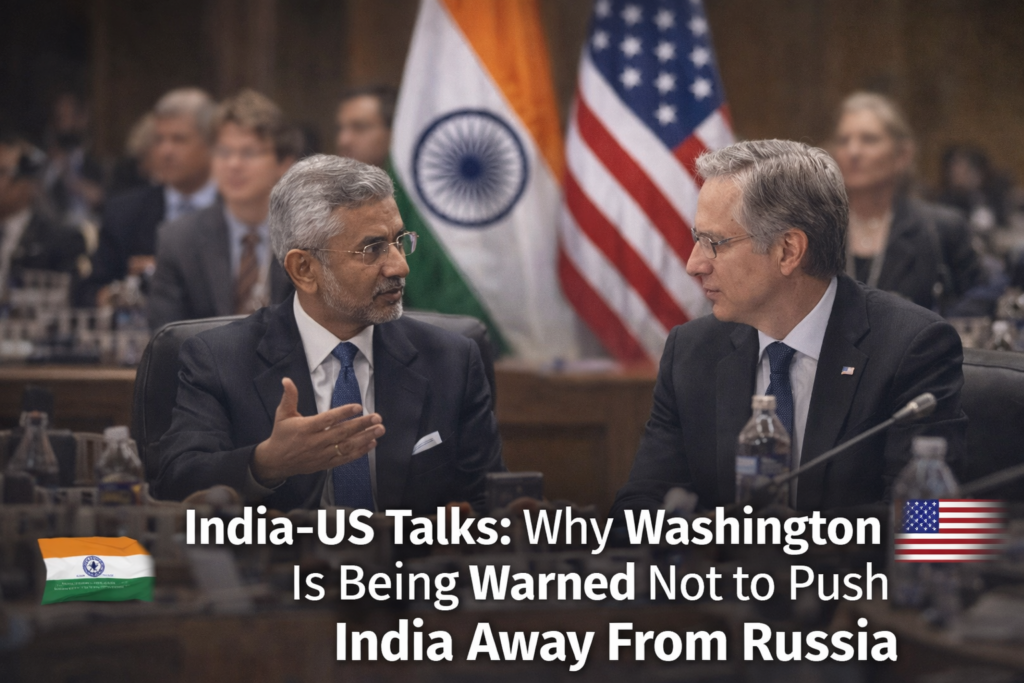
Recent comments by former US diplomat Lindsey Ford have added a new layer of realism to the ongoing debate on India’s foreign policy options, especially amid the latest developments in India-US trade relations. Speaking days after Washington moved to reduce tariffs on some Indian goods to about 18 per cent, Ford cautioned US policymakers against expecting India to abandon its long-standing relationship with Russia under external pressure.
His remarks underscore a broader strategic truth: India’s global partnerships are shaped by history, security needs and pragmatic calculations – not just short-term trade incentives.
A Complex Moment in India–US Relations
India and the United States have steadily expanded cooperation over the past decade, encompassing trade, defense, technology, and strategic alignment in the Indo-Pacific. However, this relationship was never without tension.
Trade disputes, visa rules, defense procurement and India’s relations with Russia have often emerged as points of tension.The latest tariff adjustment by the US, reportedly linked to broader trade talks, is seen by many analysts as a positive sign. Yet Ford’s comments suggest that economic concessions alone will not reshape India’s geopolitical priorities.
According to him, pressuring India to distance itself from Russia could be counterproductive, undermining trust and weakening the partnership that Washington wants to strengthen.
Why Russia Still Matters to India
India’s relations with Russia date back to the Cold War and are rooted in strategic cooperation for decades. Even today, a significant portion of India’s military equipment is of Russian origin, making defense continuity and additional supplies a practical necessity.
Beyond defence, energy security plays a major role. Subsidized Russian oil has helped India manage inflation and ensure stable fuel supplies during periods of global instability. For policymakers in New Delhi, these decisions are driven less by ideology and more by national interest.
Ford’s warning reflects this reality: It is unrealistic to expect India to “walk away” from Russia unless the US is prepared to step in with comparable military, technological and logistics support.
Trade Deals Cannot Replace Strategic Depth
The recent tariff cuts – linked by some observers to policies during the Donald Trump era – highlight how trade is often used as a diplomatic lever. But India’s foreign policy establishment has consistently indicated that trade gains alone cannot be a substitute for long-term strategic credibility.
India’s access to Europe, Russia and America is not mutually exclusive. Instead, it reflects a multi-alignment approach designed to maintain autonomy in a rapidly changing global system.
Ford’s comments clearly acknowledge that India’s position is not one of indecision but of balance – engaging multiple power centers while avoiding excessive dependence on any one.
The Risk of Overreach from Washington
Analysts say India putting too much aggressive pressure on Russia could have unexpected consequences. It could revive concerns about strategic sovereignty in New Delhi, slow down defense cooperation, or complicate cooperation on emerging technologies and regional security.
India’s approach has been to keep communication channels open with all major powers while giving priority to domestic stability and development. Attempts to frame global issues in binary terms – “with us or against us” – have historically had little traction in Indian diplomacy.
Ford’s comments appear to be intended to distance US policy from such a framework, urging a more nuanced understanding of India’s constraints and motivations.
What This Means Going Forward
For India-US relations, the conclusion is clear: progress will depend on respect for each other’s strategic realities. Trade agreements, tariff adjustments and economic incentives can strengthen relations, but they cannot overcome deeply embedded security and energy considerations.
If Washington wants a stronger partnership with India, experts argue it should focus on increasing defense cooperation, facilitating technology transfers and aligning long-term strategic goals rather than straining legacy ties.
For India, the episode reinforces its stance that strategic autonomy cannot be compromised even as it deepens engagement with Western economies.
A Relationship Built on Pragmatism
Lindsey Ford’s cautionary note may resonate beyond immediate trade talks. This reflects the growing acceptance in policy circles that India’s rise as a global player comes with its own rules – shaped by history, geography and hard-earned pragmatism.
As global power dynamics evolve, India-US ties are likely to strengthen – but only if both sides accept that partnership does not require uniformity, and cooperation does not require exclusivity.
Former US officials caution Washington against pressuring India to cut ties with Russia, highlighting New Delhi’s strategic autonomy as trade talks and tariff adjustments reshape India–US relations.