
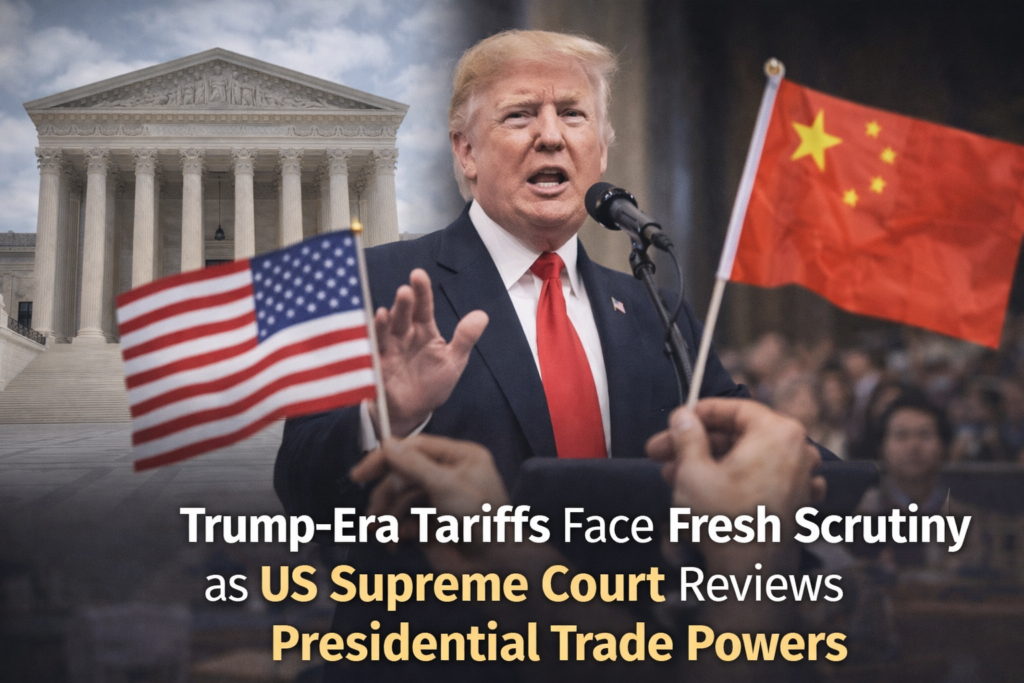
The long-running debate over US trade tariffs initiated during Donald Trump’s presidency has again come into the limelight following recent developments involving the United States Supreme Court. The issue highlights a deeper question about how much power the U.S. President should have when imposing tariffs without the direct approval of Congress.
Background: What were Trump’s tariffs?
During his presidency, Donald Trump imposed a variety of tariffs on imported goods, particularly from China. These tariffs were presented as a way to protect American industries, reduce the trade deficit, and pressure other countries to change trade practices that the US considered unfair.
The tariffs affected products such as steel, aluminum, electronics, machinery and consumer goods. While supporters argued that the measures helped American manufacturing, critics said they raised prices for American consumers and businesses.
Many of these tariffs were imposed using existing trade laws that allow presidents to act quickly in the name of national security or economic stability.
Why is the Supreme Court involved now?
Recent legal challenges have raised questions about whether some of these tariff decisions go beyond the limits set by the US Constitution. At the heart of the debate is whether Congress has ceded too much power to the executive branch under the old trade laws.
The Supreme Court is not deciding whether tariffs are good or bad policy. Instead, the focus is on who has the legal right to impose them and under what conditions.
Legal experts say the case could reshape how future presidents — regardless of party — use trade powers.
Main legal questions
Under the US Constitution, Congress has the power to regulate trade with foreign countries. Over time, Congress passed laws allowing presidents to act in emergencies or special circumstances.
The legal challenge argues that some tariff decisions relied on broad interpretations of these laws, potentially undermining the role of Congress.
If the Supreme Court imposes new limits on this authority, future tariff decisions may require stronger justification or direct approval from lawmakers.
Possible results and what they mean
If the Court rules in favor of stricter limits:
• Future presidents may face greater scrutiny when imposing tariffs.
• Congress could regain a stronger role in trade decisions.
• Businesses may see greater predictability in trade policy.
If the Court supports the existing framework:
• The President can continue to use existing laws to take swift action on trade.
•Tariffs can remain a flexible foreign policy tool.
•Legal challenges to executive business operations can be difficult.
Either way, this decision could affect US trade strategy for decades.
Impact on global trade and markets
Global markets are closely monitoring this matter. Tariffs affect supply chains, pricing, and international relations. Countries trading with the US want clarity on whether tariff policies could change suddenly or become more regulated.
For businesses, especially importers and exporters, the outcome could impact long-term planning and investment decisions.
Economists say stability in trade rules often helps markets remain calm, while uncertainty can lead to price fluctuations.
political reactions
Supporters of Trump’s approach argue that strong executive power is necessary to quickly protect national interests. He believes tariffs can be an effective negotiating tool.
Opponents argue that unchecked tariff authority could harm consumers and circumvent democratic oversight. He says that Congress should play a strong role in decisions affecting the economy.
The case has attracted attention from all parties as it could affect future presidents of both major political parties.
Why this matters beyond Trump
Although the tariffs were initiated during the Trump administration, the court’s decision will not be limited to one president. It could redefine the balance of power between Congress and the White House.
This makes the matter particularly important as trade tensions, economic competition and global supply chains evolve.
Conclusion
The renewed focus on Trump-era tariffs and the role of the Supreme Court is a critical moment in US trade policy. At stake are not just past decisions, but also how future leaders will manage trade, economic security and constitutional rights.
As the case develops, its impact will likely extend far beyond the courtroom – shaping global trade relations and the rules that govern them.
The US Supreme Court is reviewing key legal questions around tariffs imposed during the Trump administration, a move that could reshape America’s trade policy.