
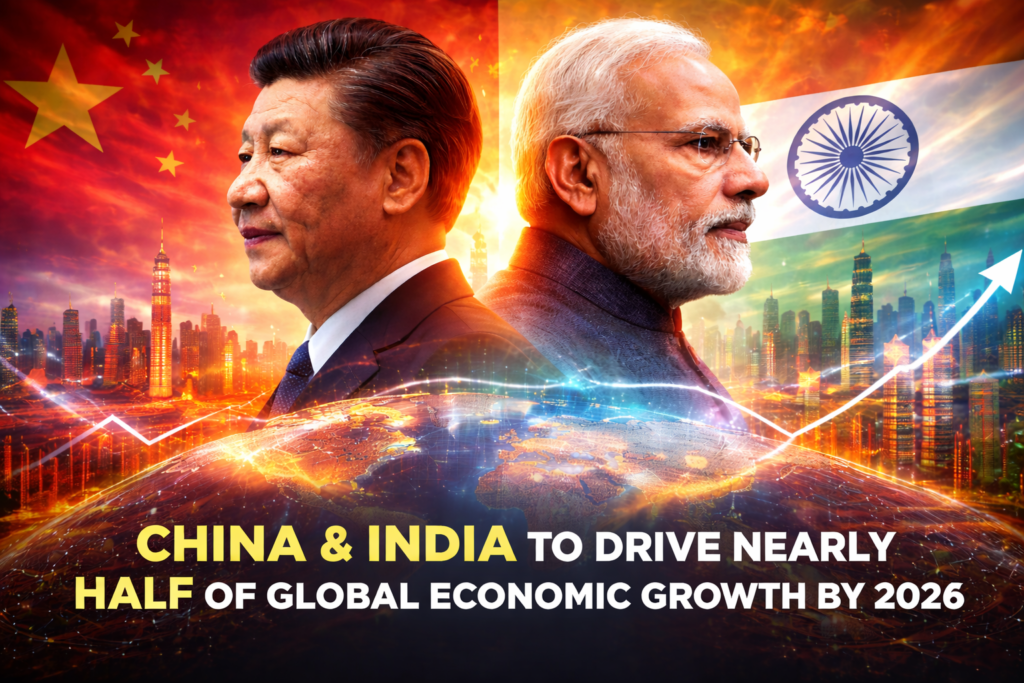
As the world economy adjusts to post-pandemic realities, supply chains shift, and geopolitical equations evolve, one trend is becoming increasingly clear: the center of global economic momentum is shifting decisively to Asia. According to recent international economic assessments, China and India together are expected to contribute about 43.6% of global economic growth by 2026, highlighting the growing influence of these two Asian giants on the world stage.
This launch is not just a numerical milestone. This reflects the deep structural changes underway in the global economy, where emerging markets—particularly in the Asia-Pacific region—are playing a more decisive role than ever before.
Asia-Pacific: The New Growth Engine
It is estimated that the Asia-Pacific region will account for almost half of total global economic growth over the next few years. While many countries contribute to this expansion, China and India stand out because of their scale, population size and economic depth.
China, despite experiencing a gradual decline in growth compared to its earlier decades, remains a manufacturing powerhouse and a central hub in global trade networks. On the other hand, India is emerging as one of the fastest growing major economies driven by rising domestic consumption, digital transformation, infrastructure expansion and young workforce.
Together, these economies are shaping a new growth narrative – one that depends less on Western demand cycles and more on internal markets and regional integration.
China’s Evolving Economic Role
China’s contribution to global growth in the coming years is expected to come from its continued dominance in advanced manufacturing, renewable energy, electric vehicles and technology-driven industries. While the country faces challenges such as population aging, real estate adjustment and global trade tensions, it is actively rebalancing its economy toward innovation and high-value production.
Investments in green energy, artificial intelligence and semiconductor capabilities are helping China maintain its relevance as a global economic driver. Additionally, its deep trade ties in Asia, Africa and Europe ensure that its economic performance has an impact far beyond its borders.
India’s Growth Story Gains Momentum
India’s rising contribution to global growth is often described as one of the most significant economic stories of the decade. With a population that has surpassed China’s, India benefits from a large domestic market that fuels consumption-led growth.
Government initiatives focused on infrastructure development, manufacturing incentives, digital public services, and startup ecosystems are accelerating economic activity. Sectors such as information technology, pharmaceuticals, renewable energy, and electronics manufacturing are expanding rapidly.
Unlike export-dependent economies, India’s growth is increasingly supported by internal demand, which provides a degree of resilience during periods of global uncertainty.
Why This Matters for the Global Economy
The joint development contribution of China and India has a major impact on global trade, investment flows and policy decisions. As these two economies expand, they create demand for goods, energy, technology, and services from around the world.
For multinationals, Asia is no longer just a production base – it is a primary market. For investors, long-term growth opportunities are increasingly concentrated in Asian economies. For policymakers, understanding Asia’s economic direction is essential to shaping future trade and diplomatic strategies.
Challenges on the Horizon
Despite the optimistic outlook, the path ahead is not without obstacles. Global inflationary pressures, geopolitical tensions, climate-related risks, and financial market volatility could affect growth trajectories.
China must manage structural reforms carefully, while India faces the task of ensuring inclusive growth, job creation, and skill development at scale. How effectively these challenges are addressed will influence not only national outcomes but also global economic stability.
A Shift That Redefines the Future
The projected contribution of China and India – about 44% of global growth by 2026 – signals a historic shift in economic power. This underlines the transition towards a more multipolar world economy, where growth is no longer concentrated in a handful of developed countries.
As the Asia-Pacific region continues to grow, the global economy is being reshaped by new priorities, new markets and new leaders. China and India are not just participants in this transformation – they are at its core.
Description: China and India are set to drive nearly 44% of global economic growth by 2026, highlighting Asia-Pacific’s rising influence on the world economy.