
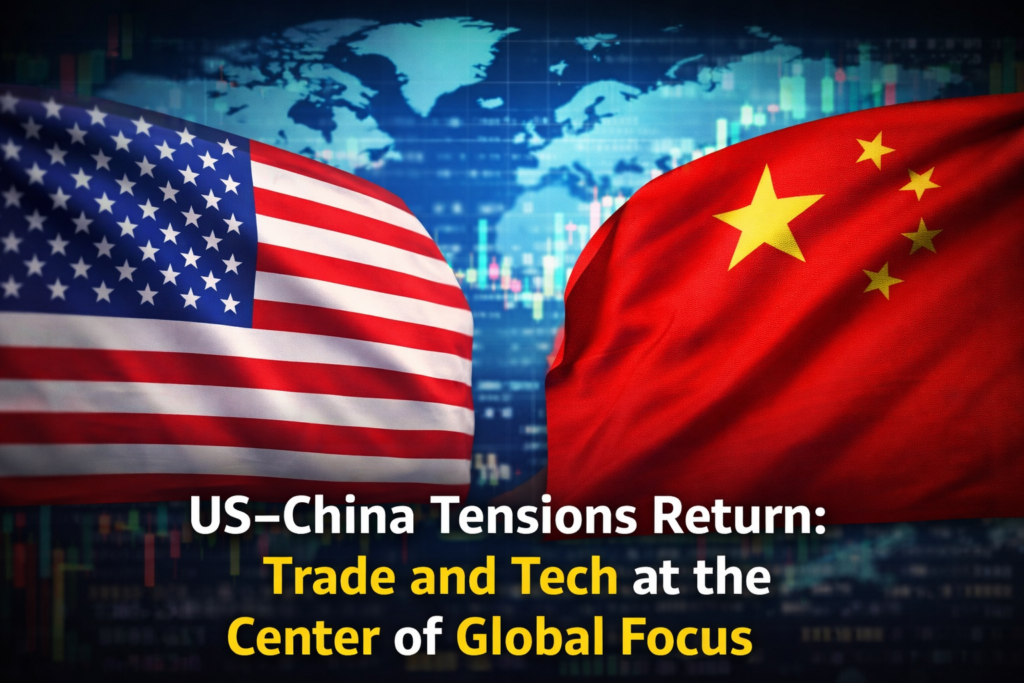
The world is closely watching the rising tensions between the United States and China as new challenges emerge for discussion on trade, technology and national security. This issue has become one of the most talked about global topics today because the decisions taken by these two powerful countries affect the entire world economy.
Why does this news matter globally?
The United States and China are the two largest economies in the world. Any disagreement between them could affect global supply chains, stock markets and international trade. In recent days, statements from both sides suggest that trust remains fragile, especially in areas such as advanced technology, tariffs and investment rules.
Although there has been no official announcement of the breakdown of talks, experts say the tone of communication has become more cautious. Governments in Europe, Asia and emerging economies are closely monitoring the situation as prolonged tensions could slow global growth.
Trade and tariff concerns resurface
One of the main concerns is trade restrictions. The US has maintained some tariffs on Chinese goods, while China continues to protect key domestic industries. These measures were originally introduced to address trade imbalances but have since become part of a larger strategic rivalry.
Businesses on both sides are feeling the pressure. Exporters are concerned about rising costs, while manufacturers are adjusting supply chains to reduce dependence on any one country. Economists have warned that if trade barriers rise further, consumers around the world could face higher prices.
Technology at the center of controversy
Technology remains a sensitive issue in US-China relations. Advanced sectors such as semiconductors, artificial intelligence and telecommunications are closely monitored by both countries. The US has imposed strict rules on technology exports, citing national security concerns.
On the other hand, China is investing heavily in domestic innovation to reduce dependence on foreign technology. Analysts say this technological competition could reshape global innovation patterns in the years to come, affecting everything from smartphones to electric vehicles.
Diplomatic efforts continue quietly
Despite the tension, diplomatic channels are open. Officials from both countries have expressed interest in maintaining dialogue and avoiding unnecessary tension. Discussions are reportedly taking place behind the scenes, focusing on economic stability and crisis management.
International organizations and global leaders are encouraging cooperation, warning that prolonged rivalry could undermine efforts to tackle shared challenges such as climate change and global health risks.
Impact on global markets
Financial markets are reacting cautiously to developments. Investors are cautious but not panicking, which suggests the market still expects dialogue rather than confrontation. Currency movements, commodity prices and stock indices are being closely monitored for any signs of growth.
Developing countries, in particular, are concerned about potential spillover effects. Less global trade or slower investment could affect employment and growth in countries that depend on exports.
what the experts are saying
Experts believe that relations between the US and China are entering a long-term stage of competition rather than short-term conflict. He suggests that both sides will continue to cooperate where necessary while competing in strategic areas.
For businesses and governments around the world, adaptability is becoming essential. Diversifying supply chains and strengthening regional partnerships are now seen as key strategies to manage uncertainty.
looking forward
As the situation evolves, the world will continue to watch how the US and China balance competition with cooperation. Although tensions remain, the focus appears to be on managing differences without causing major disruption.
Right now, this single issue is one of the most important global stories of today, highlighting how interconnected and sensitive the modern world has become.