
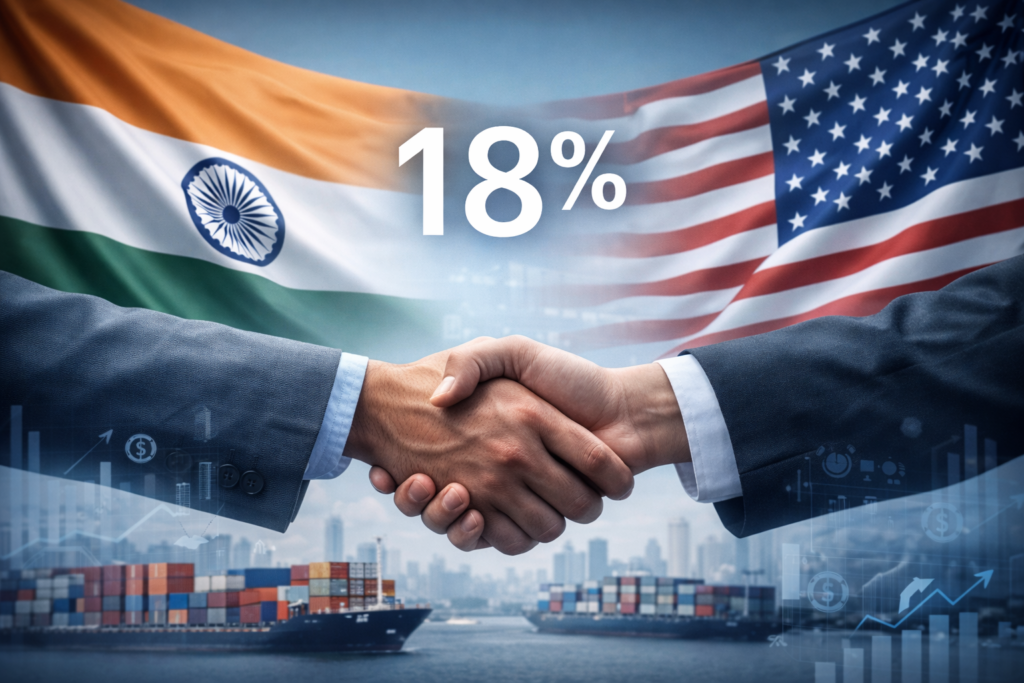
Trade talks between India and the United States have entered a critical phase, with discussions increasing over a proposed tariff structure averaging about 18 per cent on selected items. Although the figure is still part of ongoing negotiations rather than a final agreement, it has sparked significant interest among policymakers, exporters and global markets. The talks reflect a broader effort by the two countries to realign their economic partnership in the rapidly changing global trade environment.
India and the US share one of the world’s most important bilateral trade relations, valued at hundreds of billions of dollars annually. Over the past decade, cooperation has expanded beyond traditional goods trade to services, digital commerce, defense manufacturing and clean energy. However, differences over tariffs, market access and regulatory standards have often slowed progress toward a comprehensive trade agreement.
Why the 18% Tariff Discussion Matters
The mention of the 18 per cent tariff structure is seen by analysts as an attempt to find a middle path. For the United States, this reflects concerns over protecting domestic industries while ensuring fair market access. For India, this represents a balance between protecting local manufacturing and remaining competitive in global supply chains.
Discussions have reportedly focused on sector-specific adjustments, rather than imposing blanket tariffs. Major industries under consideration include electronics, pharmaceuticals, agricultural products, industrial machinery and select consumer goods. A calibrated tariff structure can help reduce long-standing frictions while encouraging predictable trade flows.
Trade experts say even a partial agreement with clearly defined tariff bands could bring stability to exporters on both sides. Businesses often value predictability as much as low tariffs, especially in an era of supply chain disruptions and geopolitical uncertainty.
Implications for Indian Industry
For India, the trade talks come at a time when the government is pushing for initiatives like “Make in India” and production-linked incentive (PLI) schemes. A structured trade deal with the US could help Indian manufacturers integrate more deeply into global value chains, especially electronics, renewable energy components and specialty chemicals.
At the same time, policymakers remain cautious about sectors that are vulnerable to import competition, including agriculture and small-scale manufacturing. Any agreement involving tariff adjustment will include safeguards to protect vulnerable domestic producers while allowing gradual market opening.
Industry leaders welcomed the discussions, stressing that better access to the US market could boost exports, attract foreign investment and help create jobs. However, he also urged negotiators to ensure that compliance costs and regulatory barriers do not outweigh the benefits of tariff cuts.
The US Perspective
From the US standpoint, the talks are part of a broader strategy to strengthen economic ties with trusted partners. With global supply chains undergoing realignment, Washington sees India as a key player in diversifying manufacturing away from overdependence on any single region.
US companies are particularly interested in improved access to India’s growing consumer market, especially in sectors such as medical devices, digital services, and high-end manufacturing. Clearer tariff rules and streamlined regulations could encourage more American firms to expand their presence in India.
Strategic and Global Context
Beyond economics, India-US trade discussions hold strategic importance. The two countries are working more closely on technology cooperation, defense production and clean energy transition. A stable trading framework will strengthen this comprehensive partnership and signal a long-term commitment on both sides.
The talks are being closely watched globally as countries re-evaluate trade policies amid rising protectionism and changing alliances. A balanced agreement between two large democracies could serve as a model for practical trade cooperation in uncertain times.
What Lies Ahead
Negotiators from both sides have stressed that discussions are ongoing and complex. Any final agreement will require careful alignment of political priorities, industry interests, and regulatory standards. While the 18 percent tariff figure has attracted attention, experts caution against viewing it as a fixed outcome rather than part of a broader negotiation process.
The next round of talks in the coming months is expected to clarify the timeline, regional coverage and implementation mechanisms. If successful, this agreement could be an important step forward in India-US economic relations, providing mutual benefits while respecting domestic priorities.
As global trade dynamics continue to evolve, the outcome of these negotiations will play an important role in shaping not only bilateral relations but also the broader economic landscape of the Indo-Pacific region.
Description:India and the United States are advancing trade negotiations focused on a proposed 18% tariff framework across select sectors. The talks aim to balance market access, domestic industry protection, and long-term economic cooperation between the two countries amid shifting global trade dynamics.