
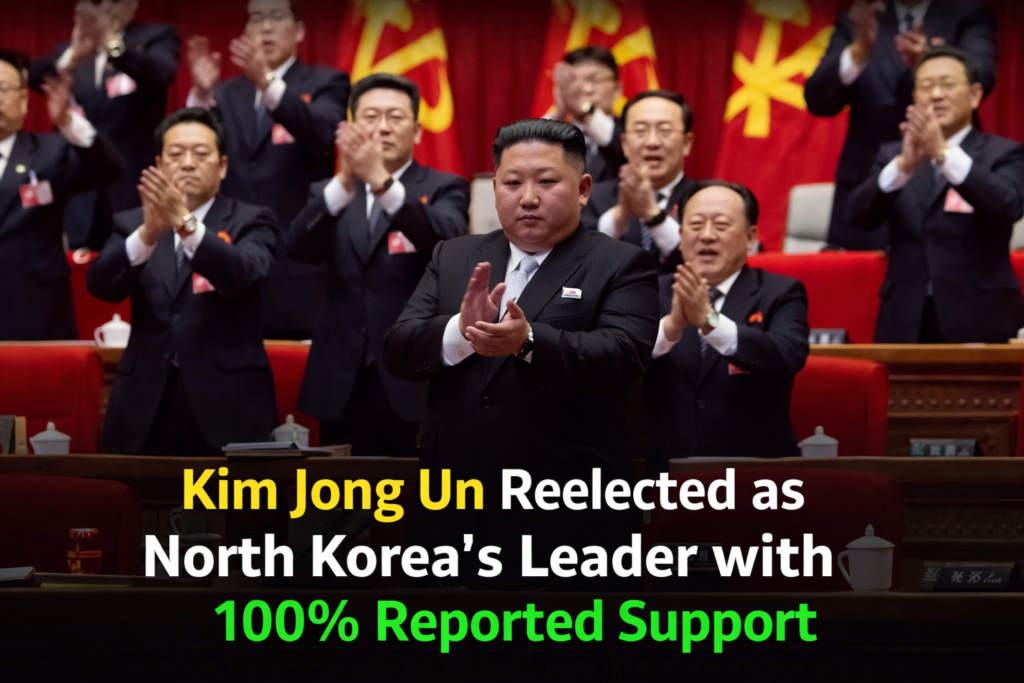
North Korean state media has announced that Kim Jong Un has once again been elected as the country’s leader, reportedly receiving 100 percent of the vote in the latest national process. Voter turnout was also described as extremely high, according to official reports released by Pyongyang, continuing a long-standing political pattern in the country.
North Korea, officially known as the Democratic People’s Republic of Korea (DPRK), operates under a political system that is very different from most Western-style democracies. Elections are held periodically, but international observers and analysts have often observed that the country presents only one approved candidate per district. As a result, results are generally predictable.
State-run media described the latest vote as a demonstration of “complete unity” between the people and their leadership. Footage broadcast on national television showed officials clapping and celebrating during formal ceremonies. Public programs were organized in various cities to mark the announcement.
However, outside experts say that the election process in North Korea does not allow open competition among candidates. International organizations have repeatedly stated that political opposition parties do not operate independently in the country. Because of this structure, reported election results often show nearly unanimous approval ratings.
Kim Jong Un has led North Korea since 2011, following the death of his father Kim Jong Il. Over the years, his leadership has focused on strengthening national defense capabilities, expanding weapons development programs, and maintaining strict state control over domestic affairs. Additionally, the country faces heavy international sanctions related to its missile and nuclear programs.
Despite global pressure, North Korea has retained its political structure without major reforms. Government messages consistently emphasize national independence, economic self-reliance, and loyalty to the leadership. Large public gatherings and state functions remain a visible part of political culture.
The latest reported result of 100 percent support in North Korean elections is nothing new. Similar results have been declared in previous years also. Analysts believe that such results are intended to demonstrate internal stability and unity to both domestic and international audiences.
Meanwhile, relations between North Korea and many Western countries remain tense. Diplomatic talks on nuclear disarmament have stalled in recent years and communication channels have been limited. However, North Korea has strengthened ties with some neighboring countries and continues limited diplomatic engagement.
According to international monitoring groups, economic conditions inside the country remain difficult. Sanctions, border restrictions and limited trade access have impacted growth. The government has promoted agricultural production and domestic industrial efforts as part of its self-reliance policy.
For many global observers, the announcement of the unanimous election result raises broader questions about governance systems around the world. Political experts note that systems vary greatly between nations depending on history, culture, and ideology.
It is important to understand that North Korea’s political model is unique and functions within its own constitutional framework. While some countries operate with competitive multi-party elections, others maintain centralized leadership structures. International reactions to such systems often depend on diplomatic relations and geopolitical considerations.
At this stage, no significant policy changes have been announced following the election results. Most analysts expect continuity in both domestic and foreign policy directions.
As global attention focuses on security developments and diplomatic tensions in East Asia, North Korea’s leadership structure is playing an important role in regional stability discussions.
The reported election results once again highlight the country’s tightly controlled political environment and cement Kim Jong Un’s long-standing leadership. It remains to be seen whether this will lead to any change in international participation.
For now, North Korea signals political continuity, unity messages and a stable outlook under its current leadership.