
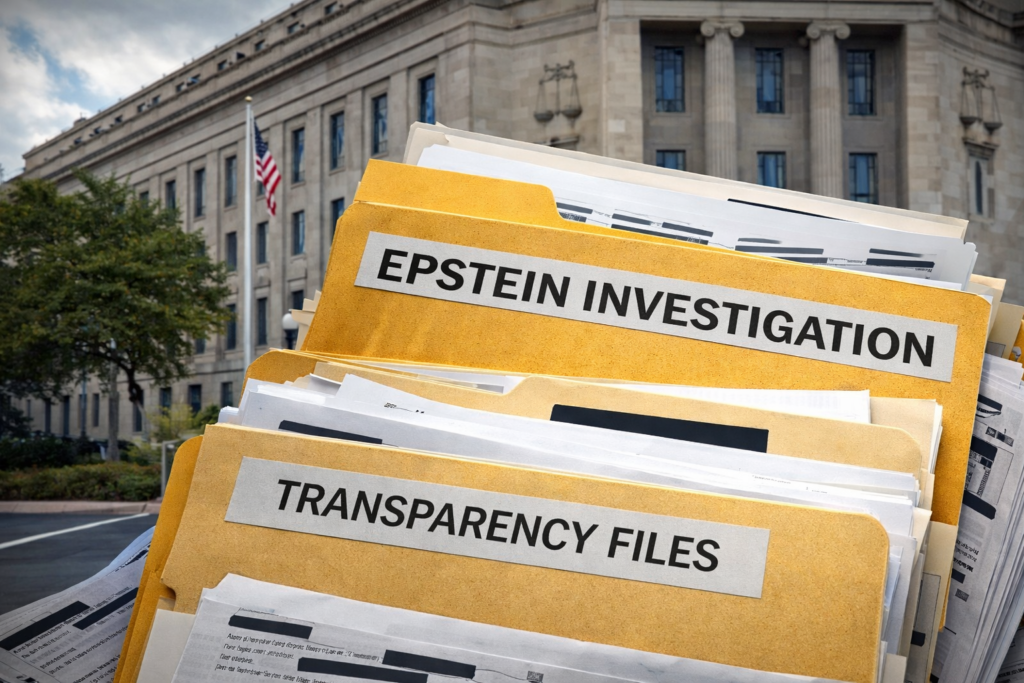
In a major development in one of the most closely watched investigations of the last decade, the United States Department of Justice (DOJ) has released a new tranche of documents and media files related to the late financier Jeffrey Epstein, drawing renewed scrutiny from lawmakers, victims’ advocates and political figures around the world.
The release, which includes more than 3 million pages of documents along with thousands of videos and images, was made available under the Epstein Files Transparency Act – a law passed by the US Congress in 2025 that obliges the government to disclose records related to the activities of Epstein, his inner circle and related investigations.
Record Release — But What’s Inside?
Deputy Attorney General Todd Blanch announced that the latest batch of materials was part of the final significant release required by the transparency law. This document dump includes investigative reports, interview transcripts, internal government communications, photos and footage that are being made public for the first time. According to the DOJ, the amount of material reflects a years-long federal investigation into Epstein and his associate Ghislaine Maxwell.
However, the documents are heavily redacted in places where victims’ identities or sensitive details could be revealed. Most of the images potentially identifying the women have been obscured, with the department defending the move as necessary to protect privacy.
Political and Public Reactions
The latest release has drawn sharp reactions from both sides of the US political aisle. Some lawmakers hailed the release as a victory for transparency and accountability, while others criticized the Justice Department for delays and alleged vagueness.
A major criticism comes from members of Congress, who argue that the heavy redactions and speed of disclosure undermine the purpose of the Epstein File Transparency Act. Lawmakers including Representative Ro Khanna have demanded access to unpublished versions of the files, claiming that citizens and elected officials have the right to fully understand the scope of Epstein’s network and potential institutional failures.
International Fallout and Scandals
The implications of the file release are not limited to the United States. In Norway, political turmoil continues after prominent figures are linked to the wider Epstein controversy. Senior diplomats have resigned amid possible corruption investigations related to their past ties to Epstein, raising questions about how far their influence extends across national borders.
Similarly, media coverage in other countries has highlighted alleged ties between Epstein’s social circles and the elite in Europe, prompting political scrutiny and public debate about transparency, power, and accountability.
High-Profile Names and Public Figures
One of the recurring themes in the new documents is the presence of powerful individuals linked in various ways to Epstein or his social networks. Reports show that the emails, photographs and correspondence include references to prominent business leaders, political figures and others who have interacted with Epstein over the years. Although inclusion in these files does not necessarily imply wrongdoing, the presence of influential names continues to fuel public interest and controversy.
Balancing Transparency and Privacy
The continued release of the Epstein files underscores the broader conflict over government transparency and the limits of public oversight of high-profile criminal investigations. For many observers, the files represent both a breakthrough in public access to previously impounded records and a cautionary tale about the complexities of balancing justice, privacy, and the public interest.
What is clear is that the Epstein files and the debates surrounding their release are far from settled. The documents are a reminder of both the reach of powerful networks and the ongoing demand for clarity and accountability in democratic systems.
Description : The US has released more than three million pages of Jeffrey Epstein files under a new transparency law, revealing documents, images, and videos tied to his criminal investigations. The move has sparked political debate, redaction criticism, and international scrutiny of connections to powerful figures