
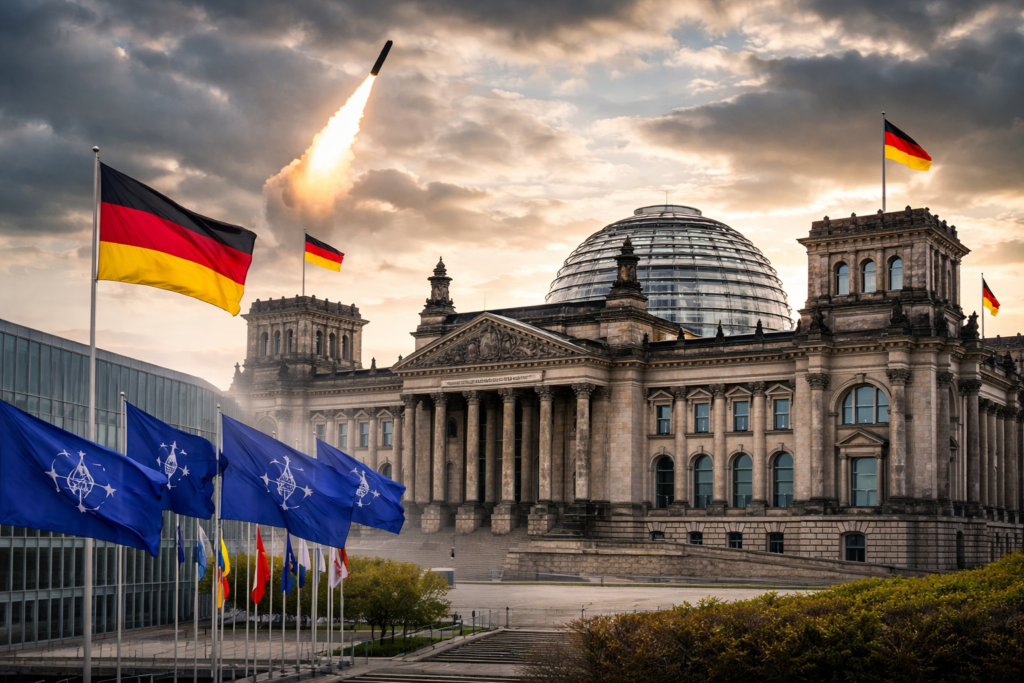
The issue of nuclear weapons has once again entered the public debate in Germany, marking a remarkable change in a country historically cautious about nuclear weapons. The renewed attention comes after comments by Russia’s Ambassador to Germany, Sergei Nechayev, who claimed that talks about Germany acquiring nuclear weapons are “no longer taboo.” His comments have attracted international attention and reignited debate about European security, NATO commitments and the future of nuclear deterrence on the continent.
A Sensitive Topic Re-Enters Public Space
For decades, nuclear weapons have been a highly sensitive topic in Germany, shaped by the country’s post-World War II constitution, international treaties, and public opinion largely in favor of disarmament. Germany is legally prohibited from developing or acquiring nuclear weapons of its own under international agreements. However, it remains part of NATO’s nuclear sharing arrangement, under which US nuclear weapons are deployed on German soil but remain under American control.
Nechayev described the increasing openness of these discussions as “worrying”, adding that the idea was being referenced not only by politicians, but also by the media and military analysts. His comments reflect broader geopolitical concerns rather than evidence of an official policy shift by Berlin.
Germany’s Legal and Strategic Position
Germany is a signatory to the Nuclear Non-Proliferation Treaty (NPT), which prohibits non-nuclear states from acquiring nuclear weapons. The country’s defense strategy has long relied on collective security through NATO rather than an independent nuclear capability.
Currently, Germany hosts US nuclear weapons as part of NATO’s deterrent framework. This arrangement has been in existence for decades and is often debated domestically, particularly during election cycles or periods of heightened international tension. While critics argue that it is contrary to disarmament goals, supporters believe that it strengthens European security without violating international law.
Russia’s Perspective and Strategic Messaging
From Moscow’s perspective, any discussion of nuclear expansion in Europe is considered destabilizing. Russia has consistently opposed NATO’s military posture near its borders, and statements by Russian officials often serve both diplomatic and strategic communication purposes.
Analysts say Nechayev’s comments may have been aimed at influencing public opinion and signaling concern rather than responding to concrete policy plans. There have been no formal proposals from the German government indicating any intention to pursue nuclear weapons, and senior officials have reiterated their commitment to existing treaties.
A Broader European Security Debate
The resurgence of this topic should be seen in the broader European security environment. Ongoing conflicts, increasing defense spending and changing threat perceptions have led many countries to reevaluate military preparedness and long-term security planning.
Germany recently announced ambitious defense modernization goals, including improvements in infrastructure, logistics and rapid deployment capabilities. These initiatives focus on conventional defense and alliance cooperation, not nuclear development. Yet, in times of uncertainty, even hypothetical discussions can take on immense importance.
Public Opinion and Political Reality
German public sentiment is largely opposed to nuclear weapons. Civil society groups, environmental organizations, and peace movements continue to advocate for nuclear disarmament and transparency. Any real move toward nuclear disarmament will face significant political, legal, and social resistance.
Political analysts emphasize that open debate does not equate to policy change. Democratic societies often revisit previously decided issues during periods of global instability, but institutional safeguards and international obligations act as strong constraints.
What This Means Going Forward
At present, instead of action, there is concern in the discussion. Germany’s defense posture is firmly based on NATO cooperation and international law. However, the fact that nuclear topics are again part of mainstream conversations highlights how dramatically the global security landscape has changed in recent years.
For Europe and the wider world, the episode serves as a reminder that nuclear weapons remain a central, if uncomfortable, part of international security discussions. How governments manage these conversations – balancing deterrence, diplomacy and public trust – will shape stability in the years to come.