
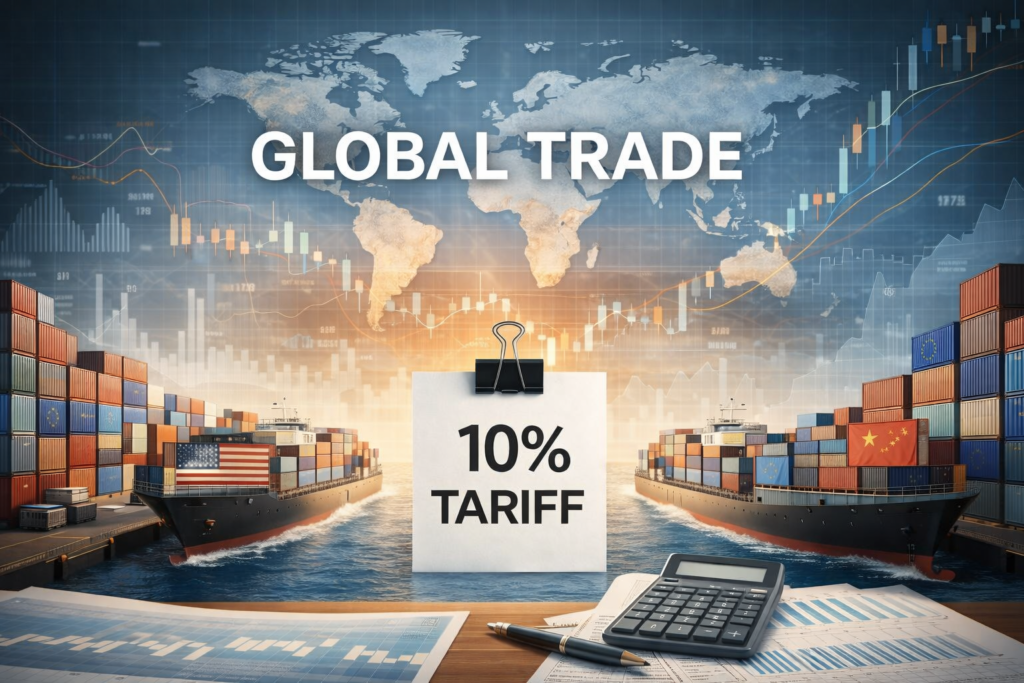
Former US President Donald Trump has announced a new proposal to impose a 10 percent global tariff on imports, a move that has attracted the attention of businesses, investors and policymakers around the world. The announcement also reignited discussion about the limits of the president’s trade powers, especially after recent indications from the United States Supreme Court that it could influence review of such decisions in the future.
What is being proposed?
According to statements from Trump’s team, the plan includes a temporary 10 percent tariff on most imported goods, aimed at protecting domestic industries and reducing the trade imbalance. The proposal is presented as a short-term measure, designed to pressure trading partners to renegotiate trade terms that the former president considers unfair to the United States.
Proponents of this idea argue that tariffs can help American manufacturers by making foreign goods more expensive, encouraging consumers and businesses to buy locally made products. He also says such measures can strengthen the country’s negotiating position in global trade talks.
However, critics warn that tariffs often lead to higher prices for consumers, as importers typically pass on the additional costs to buyers. Economists also point out that global supply chains are deeply interconnected, meaning tariffs can sometimes hurt domestic companies that rely on imported parts and raw materials.
Legal questions after Supreme Court developments
The tariff proposal comes as the Supreme Court is reevaluating how much authority federal agencies and the executive branch should have when making major economic decisions. Recent court opinions have emphasized strict interpretations of existing laws, which may affect the way future business actions are challenged or defended in court.
Although the Court has not ruled directly on this specific tariff proposal, legal experts suggest that any broad, global trade measure could face scrutiny if it is seen as exceeding the authority granted by Congress. This creates uncertainty as to how quickly or easily such tariffs would be implemented if the proposal moves forward.
Impact on global trade and markets
Global markets reacted cautiously to the announcement. Trading partners in Asia, Europe and Latin America are keeping a close eye on developments, as global tariffs could hit exports across a number of sectors, including automobiles, electronics, energy and consumer goods.
Some countries may respond by seeking negotiations, while others may consider retaliatory measures such as tariffs on US exports. Historically, trade disputes of this nature have led to market volatility and slow global growth.
Business groups in the United States have expressed a mixed reaction. Some manufacturing associations welcomed the proposal, saying it could provide temporary relief to domestic producers. At the same time, retail and technology companies warned that higher import costs could reduce profit margins and increase prices of everyday products.
political and economic importance
The tariff plan also has clear political implications. Trade policy has long been a central theme in Trump’s economic messaging, particularly his emphasis on “America First” policies. By reviving the idea of a global tariff, he is reinforcing a familiar position that appeals to parts of his political base.
For voters, the debate highlights a broader question: Should trade policy focus more on security or on open global markets? The answer often depends on one’s point of view – workers in some industries may benefit from protection, while consumers and exporters may prefer lower trade barriers.
what happens next?
At this stage, the tariff proposal remains a policy declaration rather than an active law. Any implementation will depend on legal authority, political support and possible court challenges. Investors and businesses are likely to closely monitor official actions before making major decisions.
Trade experts advise companies to be prepared for a number of scenarios, including possible delays, amendments or negotiations with trading partners. For consumers, the impact – if any – will likely appear gradually through price changes or changes in product availability.
a moment of uncertainty
The proposed 10 percent global tariff highlights the ongoing uncertainty in international trade policy. As legal interpretations evolve and political debates continue, the future of such measures remains unclear. What is certain, however, is that trade decisions of this scale have wide-ranging consequences, not just for governments, but also for businesses and households around the world.
For now, the global economy is waiting to see whether this proposal becomes policy – or remains part of the broader political and economic debate shaping the next phase of international trade.
A proposed 10% global tariff plan has sparked fresh debate on trade policy, market impact, and legal authority in the United States.