
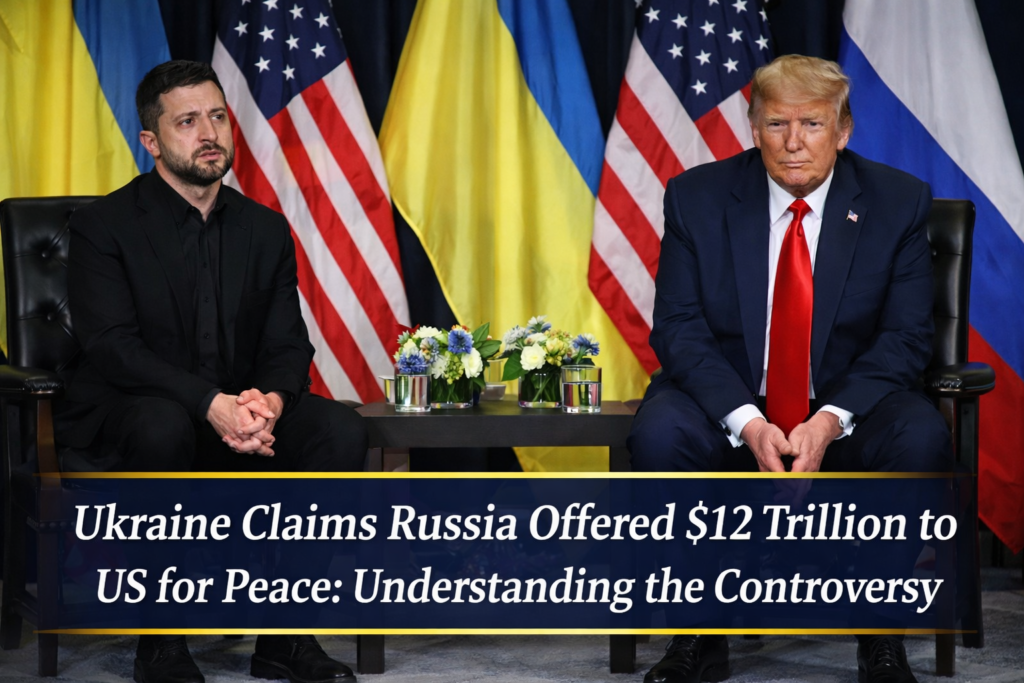
A fresh claim by Ukraine has added a new and controversial dimension to the ongoing Russia-Ukraine war. Ukrainian President Volodymyr Zelensky has said that Russia has reportedly made a huge economic offer of $12 trillion to the United States in exchange for a peace accord – a claim that has sparked debate in diplomatic and strategic circles around the world.
According to Zelensky, the proposal was reportedly presented during discussions between Russian negotiator Kirill Dmitriev and US representatives. The package, described as an economic stimulus tied to peace talks, has been informally dubbed the “Dmitriev Package”. Although Moscow has not publicly confirmed the claim, the statement raises serious questions about the future direction of the conflict and the global balance of power.
Understanding the Scale of the Claim
The figure mentioned—$12 trillion—is extraordinary by any measure. To put this in perspective, this amount is several times larger than Russia’s annual GDP and far exceeds the size of most international aid or reconstruction schemes seen in modern history. Such a number immediately raised skepticism among analysts, who noted that even the world’s largest economies would struggle to raise such a sum in a single geopolitical deal.
Ukrainian officials have not suggested that the offer was a direct cash payment. Instead, the proposal is believed to include a long-term economic framework, potentially including energy cooperation, trade access, frozen assets, investment guarantees or sanctions-related concessions. However, without official documentation, the exact structure remains unclear.
Ukraine’s Concerns and Warnings
President Zelensky has warned that any peace discussions held without keeping Ukraine at the center could undermine the country’s sovereignty and long-term security. He warned that resolutions appealing to third parties could ignore the humanitarian and territorial costs borne by Ukraine since the war began.
Ukraine says peace cannot be limited to economic calculations alone. From Kyiv’s perspective, a lasting solution must address accountability, territorial integrity, and security guarantees – not just financial incentives. Ukrainian leaders fear that their talks could set a dangerous precedent for international conflict resolution.
The US Position So Far
The United States has not publicly acknowledged receiving or considering any such proposal. US officials have consistently stressed that any peace process must directly involve Ukraine and respect its independence and internationally recognized borders.
Washington has also reiterated its stance that economic pressure, including sanctions, remains an important tool to prevent further escalation. According to many policy experts, accepting or considering large-scale economic proposals from Russia without concrete changes on the ground would risk undermining international norms.
Why the Claim Matters Globally
Even if the proposal remains unverified, its emergence highlights the increasing complexity of the war as it enters another protracted phase. The conflict has already reshaped global energy markets, defense strategies and diplomatic alliances. A claim of this magnitude underlines how great the risks have become, not only for Ukraine and Russia, but also for the global economy.
The situation also reflects growing fatigue among global powers, many of whom are quietly looking for ways to ease tensions amid growing economic and political pressures. However, there is a fine line between encouraging peace and enabling power-based bargaining that sidelines affected countries.
Strategic Messaging or Serious Proposal?
Some analysts believe the claim may be part of a broader strategic message rather than a formal offer. By presenting such a large figure, Russia is signaling its willingness to negotiate – or is attempting to test divisions among Western allies. Others argue that it may be designed to influence public opinion by portraying Russia as open to peace, while shifting responsibility for the ongoing conflict elsewhere.
Without independent verification, the claim remains disputed. Nevertheless, it has successfully drawn attention to the behind-the-scenes diplomatic maneuvering that often accompanies high-profile wars.
The Road Ahead
As the conflict continues, discussions on peace—formal or informal—are likely to intensify. Whether or not the purported $12 trillion offer exists in concrete form, the episode highlights an important reality: any lasting solution will require transparency, inclusion, and respect for international law.
For now, Ukraine is insisting that peace cannot be bought at the cost of its future. Meanwhile, the world is watching closely as diplomacy, economics and geopolitics once again intersect in one of the most consequential conflicts of our time.
Ukraine has claimed that Russia floated a massive $12 trillion economic proposal to the United States as part of informal peace discussions. The claim has sparked global debate, raising questions about diplomacy, strategy, and the future direction of the ongoing Russia–Ukraine conflict.