
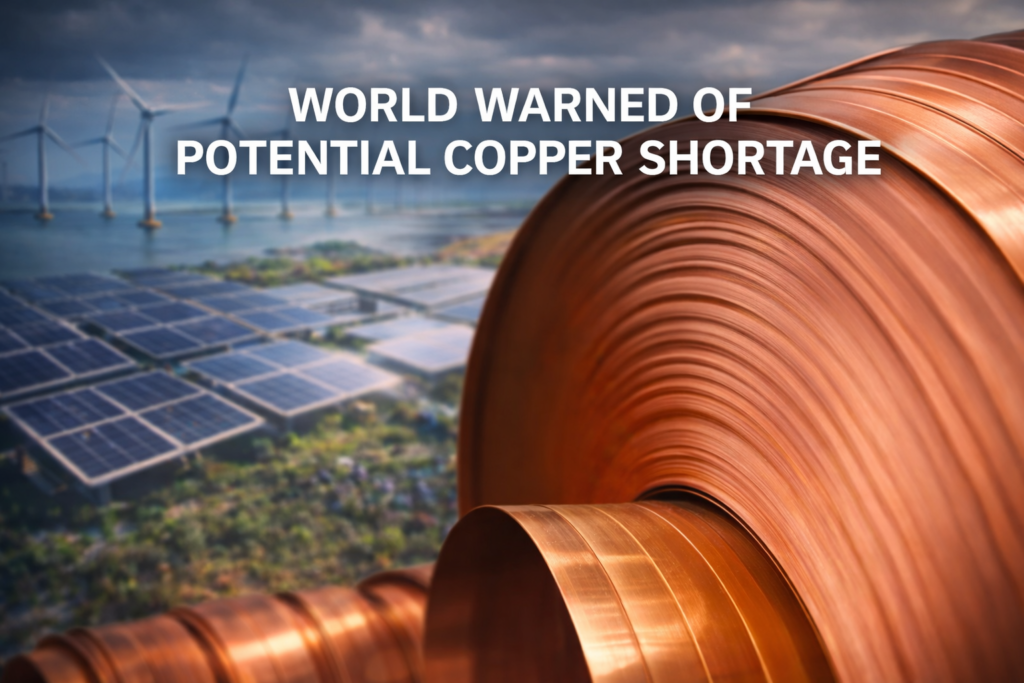
According to recent insights highlighted in the Economic Survey of India, the global economy may soon face a significant supply challenge as demand for copper is growing faster than production. Often called “the metal of electrification,” copper plays a central role in powering modern infrastructure – from renewable energy grids and electric vehicles to data centers supporting artificial intelligence. Analysts now warn that without timely investment and strategic planning, the gap between supply and demand could widen in the coming years.
Growing Demand in an Electrified World
Copper has long been the backbone of industrial growth, but its importance has increased manifold with the global shift towards clean energy and digital expansion. Renewable energy systems such as wind turbines and solar farms require far more copper than traditional energy sources. Electric vehicles alone use several times more copper than conventional automobiles due to the extensive wiring and battery components.
Additionally, the rapid spread of AI-powered technologies has accelerated data center construction. These facilities require vast amounts of electricity and, by extension, copper-based transmission networks to operate efficiently. The Economic Survey shows that this dual push towards electrification and digital infrastructure is reshaping commodity markets, making copper one of the most strategically important metals of the decade.
Supply Pressures and Market Volatility
While the demand is continuously increasing, the supply is facing frequent disruptions. Mining setbacks in major copper-producing regions including Indonesia, the Democratic Republic of the Congo and Chile have contributed to uncertainty in global markets. Production disruptions, regulatory challenges and logistics constraints have made copper prices increasingly volatile, raising concerns for industries dependent on stable raw material costs.
Recent analyzes also indicate that the global copper supply chain is already under strain as countries compete to secure the resource amid geopolitical tensions and a rapidly growing green transition. This competition could intensify if the shortage becomes more pronounced, potentially influencing trade policies and investment strategies around the world.GIS report
Why Copper Matters More Than Ever
Unlike some items that can be replaced, copper remains difficult to replace without compromising efficiency. Its exceptional conductivity and durability make it indispensable for energy transmission, electronics, construction and transportation. As nations pursue climate goals and modernize infrastructure, copper demand is expected to remain structurally strong rather than cyclical.
Experts stress that the timeline for opening new mines could extend by more than a decade due to environmental clearance, financing constraints and technical requirements. This lag means supply cannot quickly respond to sudden surges in demand – a key reason economists are urging prompt action.
Implications for Emerging Economies
For developing countries like India, the outlook holds both risks and opportunities. On the one hand, higher copper prices could increase project costs for infrastructure, renewable energy installations and manufacturing expansion. On the other hand, the situation could encourage domestic exploration, recycling initiatives and innovation in material efficiency.
Strategic storage and diversified import partnerships are also being discussed as possible security measures. Policymakers are increasingly viewing critical minerals not only as economic inputs but as pillars of long-term national resilience.
Industry Response and Investment Outlook
The private sector has already started responding to these signals. Mining companies are exploring untapped reserves, investing in new technologies to improve extraction efficiency, and expanding recycling capabilities to recover copper from electronic waste. Recycling, in particular, is gaining attention as a faster and more sustainable way to supplement the supply.
Financial markets are also watching closely. Commodity investors often interpret tight supply forecasts as a harbinger of price increases, although analysts caution that market movements will depend on how quickly new production comes online.
A Turning Point for Resource Planning
The broader message from policymakers and industry observers is clear: copper is no longer just another industrial metal – it is becoming a strategic resource for the future of energy and technology. Active planning, international cooperation and sustainable mining practices may determine whether the world makes this transition smoothly or faces long-term shortages.
For now, the warning serves less as a prediction of immediate crisis and more as a call for preparedness. If governments and industries align investments with projected demand, the coming decade could be a period of innovation and infrastructure development rather than disruption.
However, the window for action may be narrower than it appears. As electrification accelerates and digital ecosystems expand, the role of copper will deepen – making today’s planning decisions critical to tomorrow’s economic stability.
Description:Global demand for copper is rising due to electrification, renewable energy, and AI-driven infrastructure. India’s Economic Survey warns that supply disruptions and slow mine development could create future shortages, prompting calls for strategic investment and resource planning